12.05.2026 A masterpiece of our brain
The Efficiency of Small Neural Networks: How Our Visual System Prioritizes Simplicity Over Physical Precision When Assessing Surfaces
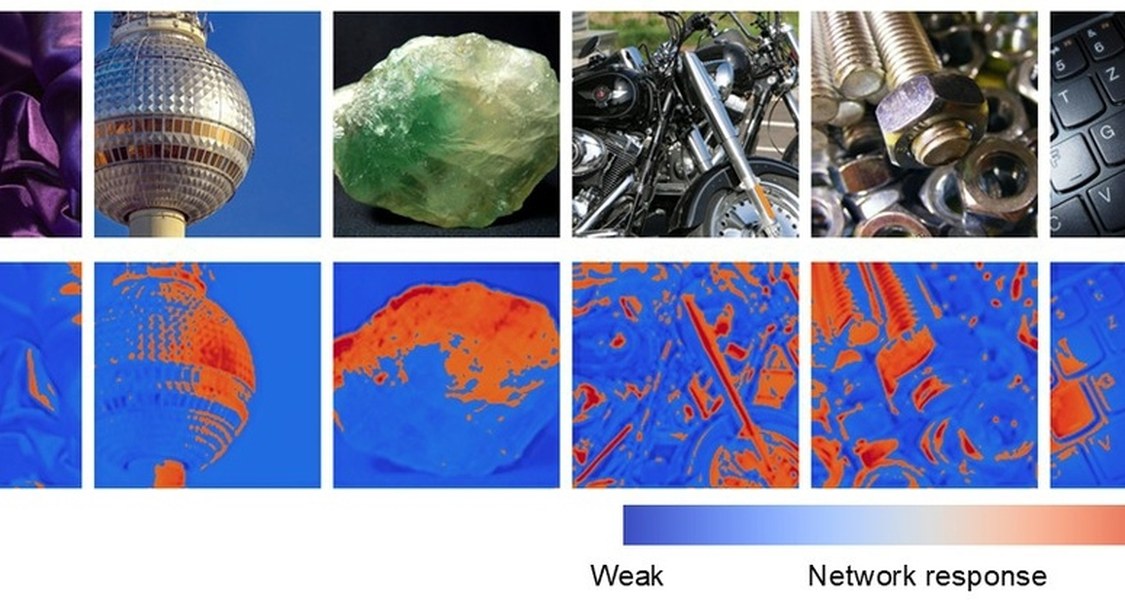
Why does a polished apple look shiny, while a loaf of bread looks dull? That sounds like a simple question, but for our brains, it is anything but simple. For decades, researchers have known that shiny objects often produce bright mirror reflections that make polished surfaces appear glossy. What was previously unknown: How does the brain distinguish these specular reflections from similar visual patterns caused by other factors, such as markings or surface irregularities? A study led by researchers in the Department of Perceptual Psychology at Justus Liebig University Giessen (JLU) suggests that the brain solves this problem not with complex physics, but with surprisingly simple visual calculations. The results were published in the journal “Nature Human Behaviour.”
For their study, the researchers took a new approach. Instead of using hand-drawn images, they employed machine learning to generate thousands of computer-rendered images of objects. They then measured how shiny each image appeared to the viewer. “The key point was that the images also showed cases where the physical reflection and the perceived gloss did not always match—because these discrepancies can provide insight into the characteristic computational strategies and assumptions underlying human vision,” said JLU perception researcher Prof. Dr. Roland W. Fleming, spokesperson for the Cluster of Excellence TAM – The Adaptive Mind and senior author of the study.
The researchers then trained two types of artificial neural networks. One network was trained to replicate human judgments of gloss, while the other was designed to learn to estimate physical reflectance. This was based on the following reasoning: If humans do indeed perceive the physical properties of the world, both tasks should require a similar neural network mechanism. But that was not the case.
Instead, the researchers found that “shallow” networks with only three layers were surprisingly good at predicting human judgments of gloss. Even an extremely small network with just a single filter could capture human responses to a significant degree. This filter appeared to combine generic visual sensitivities—such as contrast, oblique specular patterns, and the color statistics of natural lighting—in a way that improved the detection of specular reflections. In contrast, estimating the actual physical reflection required deeper networks and more training data. In other words: the computations required to map human perception were much simpler than those required to recognize the physical reality.
“This suggests that our visual system does not attempt to work backward from the image to reconstruct the physical properties of the world every time we look at a shiny object,” says Dr. Takuma Morimoto, the study’s lead author. “Instead, the brain appears to rely on efficient, reusable visual computations that are sufficient for stable perception across a wide range of situations.”
Another key finding is the scientific significance of small, interpretable neural networks. While leading AI labs are developing ever-larger models trained on massive servers, the researchers here deliberately chose the opposite approach: they built the smallest networks that could still capture human perception. This makes it easier to examine the computations—and transforms machine learning from a mere modeling tool into a means of uncovering mechanisms in the brain.
“Gloss was our test case, but our findings go far beyond glossy surfaces,” says Prof. Fleming. “If small data-driven networks can demonstrate the computations behind the perception of gloss, similar approaches could help us understand how biological systems solve many other difficult problems.” The researchers now want to find out whether the perception of 3D structures and other properties can be explained by related strategies.
The study suggests that some of our brain’s most impressive achievements arise from compact, general computational principles—rather than from solutions devised separately for each perceptual task. “This opens up a new path to understanding the hidden logic of complex biological systems, both within and beyond vision,” said Prof. Fleming.
Publication
Morimoto, T., Akbarinia, A., Storrs, K., Cheeseman, J. R., Smithson, H. E., Gegenfurtner, K. R., & Fleming, R. W. Human gloss perception reproduced by tiny neural networks. Nature Human Behaviour (2026). https://www.nature.com/articles/s41562-026-02445-0
Contact
Prof. Dr. Roland W. Fleming
Abteilung Allgemeine Psychologie
Telefon: 0641 99-26140
E-Mail: roland.w.fleming@psychol.uni-giessen.de