21.08.2026 Redefining the Brightness of Colors
JLU Research Team Highlights the Limits of the International Unit of Measurement, the Candela: A Simple RGB Rule Predicts How Bright Colors Appear to People
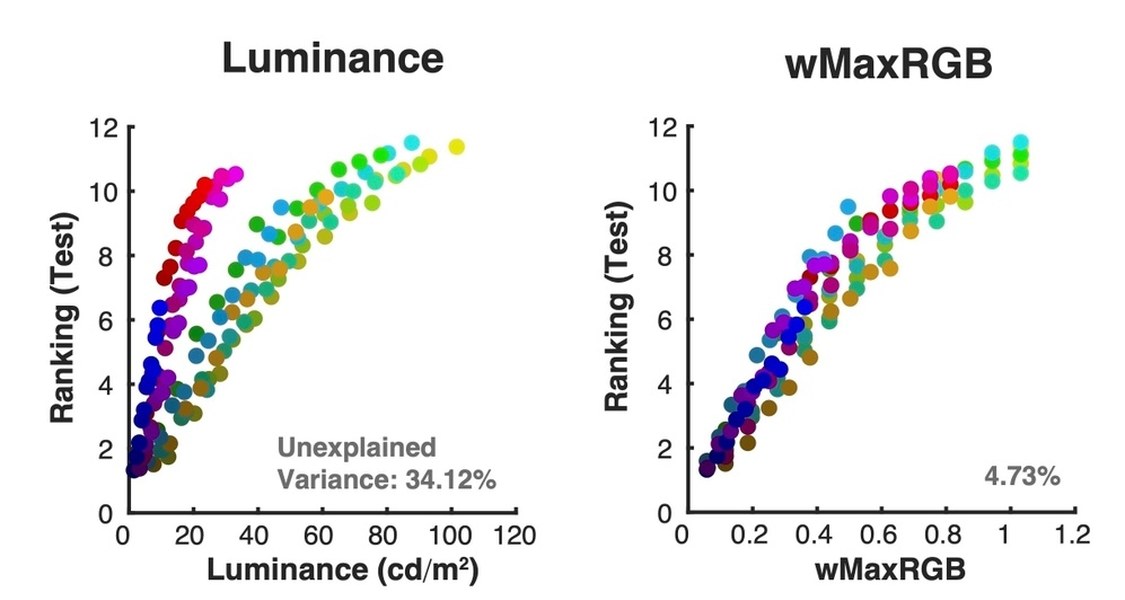
The candela, the international unit of luminous intensity that has been in use for nearly a century, forms the basis of photometry. According to a recent study, measurements based on this unit systematically misestimate the brightness of colored light sources and deviate significantly from human perception. An international team led by perception researcher Prof. Dr. Karl Gegenfurtner of Justus Liebig University Giessen (JLU) discovered a surprisingly simple rule for determining how bright colored light surfaces actually appear: According to this rule, the perceived brightness can be predicted almost entirely by considering only the highest value of the three weighted color components—red, green, and blue. This rule explains over 95 percent of the observed assessments and outperforms all established photometric models.
“The candela is the only SI unit that is based not on pure physics but on human perception,” says Prof. Gegenfurtner. The fact that the quantities derived from it deviate significantly from this perception—especially when it comes to colors—has implications for the labeling of light sources, the calibration of screens, and the planning of lighting in offices, on streets, and in living spaces. For the participants in the study, which has now been published in the journal *Proceedings of the National Academy of Sciences (PNAS)*, saturated colors appeared significantly brighter, and blue light contributed more to perceived brightness than photometric measurements predict.
Gegenfurtner attributes the discrepancies to the fact that the standard, developed in the 1920s, is based on the assumption that the brightness of a color mixture is the sum of its individual components. Furthermore, measurements using traditional brightness comparisons are considered slow, difficult, and not very reliable across different individuals. The Giessen team in the Cluster of Excellence “The Adaptive Mind” (TAM) took a different approach for its research and simply had the participants sort colored fields from light to dark.
The method proved remarkably robust: The participants ranked 144 colors, and this ranking was nearly identical when the task was repeated more than half a year later. It remained just as stable when the same individuals repeated the task at home on their own, uncalibrated monitors, and when an additional 486 participants completed it online. This made it possible to measure multicolor brightness on a large scale for the first time.
Using this data, the team tested a variety of possible models, including luminance, radiance, and established color appearance models such as CAM16. “None of these models captured the pattern. What ultimately worked was surprisingly simple,” explains Gegenfurtner: “You take the red, green, and blue components of a color, weight them, and keep only the highest value. This allows brightness judgments to be predicted almost perfectly.”
The same signature was also evident in the brain: In EEG measurements, responses to rapidly flickering lights followed luminance exactly, as classical photometry would predict. In contrast, during slow modulation—which more closely resembles calm observation—the responses followed the new rule. Even in a real-world room where color-adjustable LED lights were used, participants consistently chose the lighting that the new model rated as brighter. This is a clear indication that the rule actually describes everyday vision.
These findings come at a time of rapid technological change: Modern LEDs make it possible to freely alter the color composition of light while maintaining a constant luminance. Thus, two installations can be measured as having the same brightness yet still appear visibly different. The study thus not only provides a reliable measurement method for the brightness of mixed colors but also suggests a simple, previously unknown basis for calculating the perception of light in everyday scenes. “These findings could significantly influence the planning of lighting in buildings, the calibration of screens, and the development of energy-efficient light sources in the future,” emphasizes Gegenfurtner.
Publication
S. Guan, J. Chen, R. Ennis, M. Toscani, M. Valsecchi, A. van Doorn, J. Koenderink, & K.R. Gegenfurtner, “Perceptual and neural constraints on photometric measures of heterochromatic brightness,” Proc. Natl. Acad. Sci. U.S.A. 123 (34) e2610398123, https://doi.org/10.1073/pnas.2610398123 (2026).
Funding
European Research Council, ERC Advanced Grant Color 3.0 (884116); German Research Foundation (DFG), SFB/TRR 135 (Project No. 222641018); DFG Cluster of Excellence EXC 3066/1 “The Adaptive Mind” (533717223).
Contact
Prof. Karl R. Gegenfurtner, General Psychology
Email: gegenfurtner@uni-giessen.de